Before anything else, there was a clearance.
In late 1996, as Richard Ashcroft and the producer Youth worked on the material that would become Urban Hymns, The Verve's management negotiated a license, reportedly through Decca Records, for a sample — five notes, in the original agreement — from the 1966 Andrew Loog Oldham Orchestra's instrumental version of "The Last Time," a song credited to Mick Jagger and Keith Richards. The publishing was controlled by ABKCO, the company founded by Allen Klein. The terms were fifty percent.
Ashcroft wrote "Bitter Sweet Symphony" around and on top of that loop. The string arrangement was by Wil Malone, who recorded new orchestral layers built on the chord progression of "The Last Time." Those strings were taped before Christmas 1996. Ashcroft wrote the melody and the lyric. The rhythm section was new. The form — six minutes, a ballad disguised as a march — was new. What remained of the Oldham recording, underneath, was the hook and its mood.
On June 11, 1997, the video was released. On June 16, the single followed, on Hut Recordings.
The video was directed by Walter Stern.
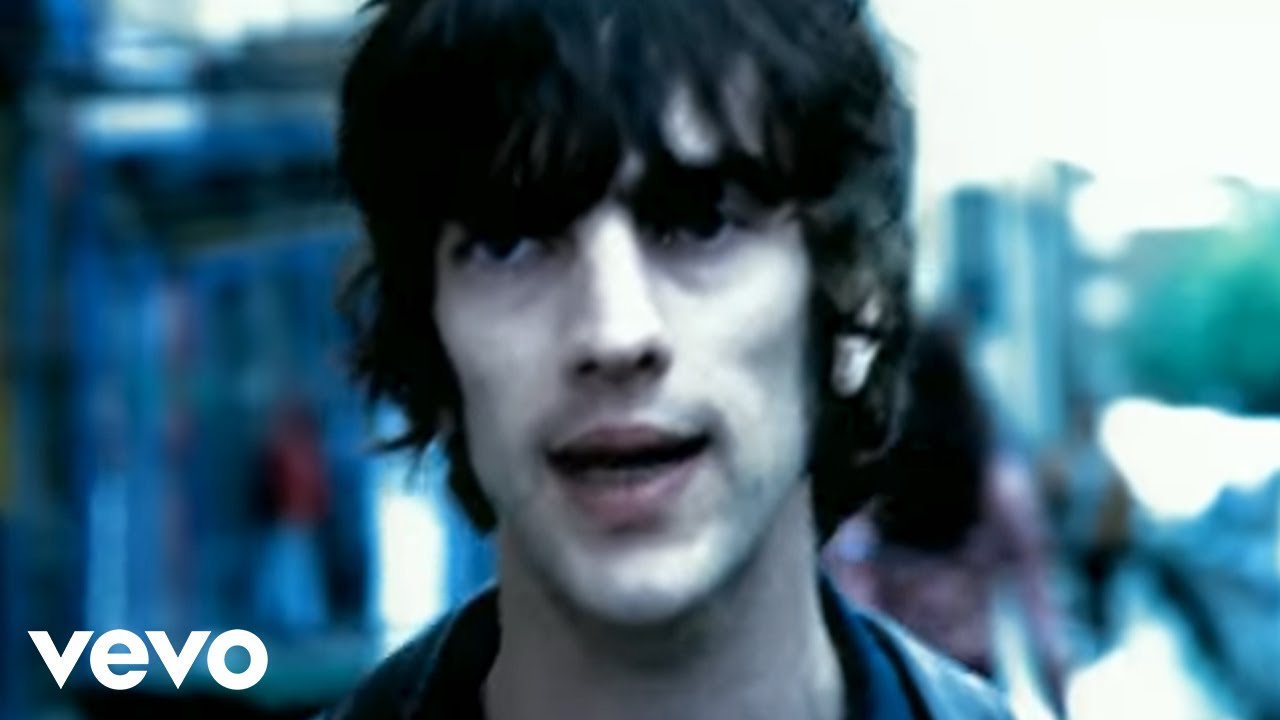
Stern had come out of the British music-video establishment through Academy Films; the year before, he had directed The Prodigy's "Firestarter," and the year after, he would direct Massive Attack's "Teardrop." For "Bitter Sweet Symphony," he wanted — by his own later account, reported in El País — to honor Baillie Walsh's 1991 video for Massive Attack's "Unfinished Sympathy," another long, unbroken walk through a street. He chose Hoxton Street in London's East End. The starting point, according to the local history project Layers of London, is the southeast corner of the junction with Falkirk Street.
Ashcroft walks. The camera tracks in front of him. He looks at nothing. He bumps into people. He climbs onto the hood of a parked car. He does not stop. Toward the end the rest of the band joins him, walking beside. The sequence is staged to read as a single unbroken take — some small cuts are visible on close inspection, but the effect is sustained — and Ashcroft's body language is close to a confrontation: weight forward, shoulders forward, eyes forward, no expression. Whether the pedestrians are all extras is not fully documented. They are almost certainly mostly extras. A handful of retrospective fan accounts insist that some collisions were with real passers-by; Stern and Ashcroft have not publicly confirmed this either way.
The single reached number two on the UK Singles Chart. In the United States it peaked at number twelve on the Billboard Hot 100 and in the top four on the Modern Rock Tracks chart. In Europe it went top ten in Italy, Norway, Sweden, and elsewhere.
And then the second story started.
Allen Klein, looking at the finished track, concluded that The Verve had used more of the Oldham recording than the original five-note license had covered. ABKCO sued. The settlement, reached in late 1997, was essentially total: the songwriting credit was transferred to Jagger and Richards, and the publishing royalties — all of them — were assigned to ABKCO. The band did not lose the master; Virgin, through Hut, retained the recording, and the band's stake shifted to the master side of the recording, rather than the song's publishing. But the song, as a piece of writing, no longer belonged to the man who wrote it.
Ashcroft, in remarks widely repeated since and not easily traced to a single original interview, said the song was the best one Jagger and Richards had written in twenty years.
In 1998, Nike licensed the track for a television advertisement. The Verve had a standing policy against licensing their music to commercials; it did not matter. ABKCO controlled the publishing; Virgin controlled the synchronization rights. The band had no veto. They publicly distanced themselves. The advertisement ran.
Andrew Loog Oldham sued ABKCO in 1999, on the grounds that he had not been paid mechanical royalties on his own recording. The case illustrated, incidentally, how thoroughly the rights around "Bitter Sweet Symphony" had been stripped from the people whose creative work was in the grooves.
The Verve broke up that same year. The reasons were interpersonal — a long-standing friction between Ashcroft and the guitarist Nick McCabe — more than legal; but the royalty dispute sat under the breakup like weather. The song kept moving. In 1999, "Bitter Sweet Symphony" closed the final scene of Cruel Intentions; it continued to rotate on radio and in stadiums. The band reunited in 2007 and released Forth in 2008. "Bitter Sweet Symphony" returned to the setlist, and to the closing slot.
Allen Klein died in 2009. His son Jody Klein took over ABKCO.
In the spring of 2019, Mick Jagger and Keith Richards signed papers returning all future publishing and the songwriting credit to Richard Ashcroft. The gesture was forward-looking — historical royalties were not recovered — but formally, he was now the sole listed writer of the song he had written twenty-two years earlier. On May 23, 2019, Ashcroft collected the Ivor Novello award at a London ceremony. From the stage, he told the room that as of the previous month, Mick Jagger and Keith Richards had signed over all their publishing. He called the gesture kind and magnanimous. The song, he said, was finally his. He had been waiting twenty-two years to say that.
The video is what most people still remember: a man walking down a street, not looking at anyone, not being looked after by anyone either. It works the way all walks work in cities. You keep going.
Watch the video