The song began as a hum.
Nelson was not a permanent member of the group. Shara Nelson sang this song and other tracks on Blue Lines, and co-wrote "Unfinished Sympathy."
The hum became "Unfinished Sympathy." Malone wrote the string arrangement, and contemporary accounts describe it as recorded with a live ensemble rather than built primarily from samples — a distinction that mattered in 1991, when the aesthetic later called trip-hop (a term that would not enter the music press until the mid-1990s) was still being invented in real time. The song was originally titled "Kiss and Tell," and the final title is a pun on Schubert's "Unfinished Symphony."
The single was released on February 11, 1991, as the second from Blue Lines. By that point, the Gulf War had begun. On the original UK pressing, the artist was not Massive Attack. It was, simply, Massive.
The sources are clear on who decided this: the record company and management advised dropping the word, since the BBC had already deemed the name unpatriotic. Most retrospectives point to record-company pressure and the risk of a BBC radio ban; the primary exchanges between label, band, and broadcaster have not been published in any form readily available today. The name change was temporary, and the group soon returned to releasing records as Massive Attack. The single peaked at number thirteen on the UK Singles Chart.
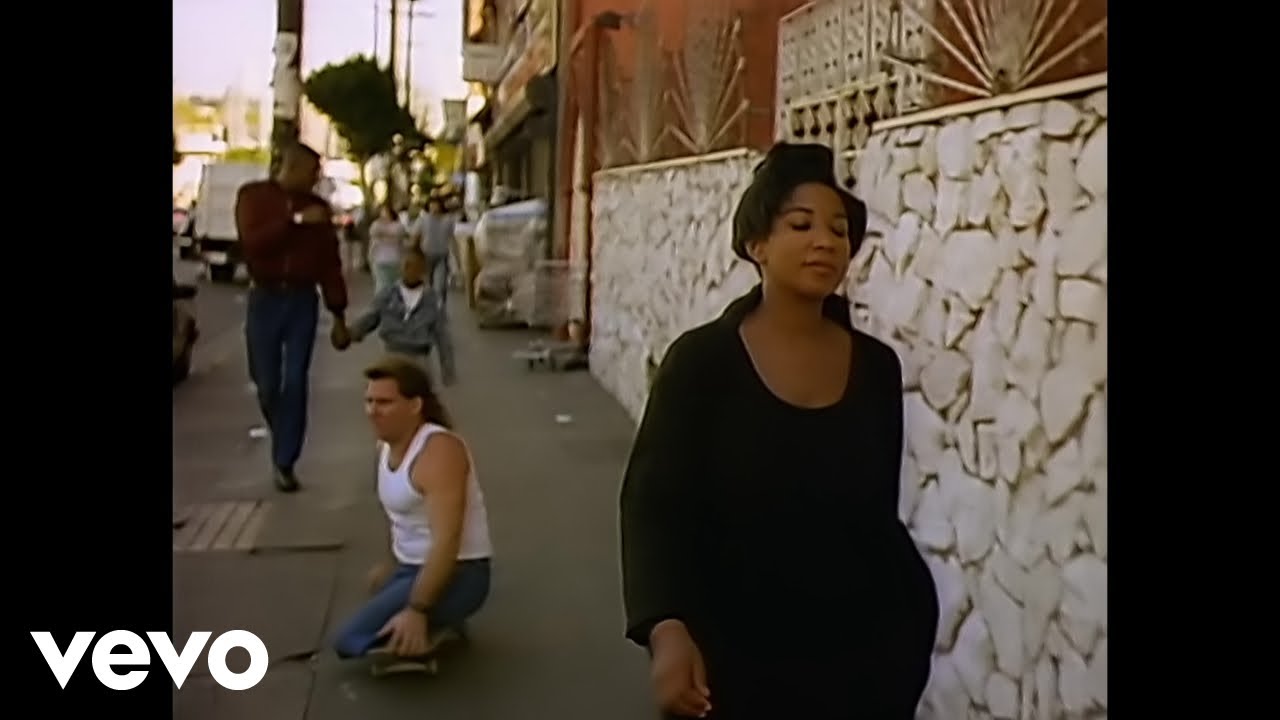
The video was directed by Baillie Walsh, who had already made the video for "Daydreaming," the album's first single. He chose, for the second, to shoot Nelson walking along a street. He chose Los Angeles.
The choice of city has since been explained by the band, in interviews cited second-hand, in practical rather than artistic terms: they wanted a steadicam operator of sufficient caliber, and they wanted the light. More precisely, the route began near 1311 South New Hampshire Avenue and ended near 2632 West Pico, a walk of several blocks shot, for all practical appearances, in a single unbroken take.
One of the more detailed technical accounts, attributed to fan-research built on interview citations, places the number at six rather than the oft-repeated "fourteen" — Kneece carried the rig until his stamina gave out, and one of those six takes was used. Whether the final take contains any concealed cuts of the kind later directors would use to manufacture the illusion of single-shot cinema is not possible to verify from the sources in circulation. Walsh and Kneece have not, to public knowledge, addressed the question directly. The claim that this was the first single-take music video, which recurs in some retellings, is not one the available sources can confirm. It was unusually committed, unusually long, and unusually well-executed; the historical superlative is more enthusiasm than fact.
The people on the street raise a more interesting question. The suggestion that real local gang members appear in the video is more than lore: 3D told Melody Maker that the gang at the beginning with the dog were real and lived there, while some of the other passers-by were extras. What is likely is that the production blended a small number of extras into the regular pedestrian life of that stretch of West Pico — a result that reads, thirty years later, as closer to documentary than it probably was.
Massive Attack would not record another song quite like "Unfinished Sympathy." Shara Nelson left after Blue Lines and released her solo debut, including the single "Down That Road," in 1993. Baillie Walsh kept directing videos — Kylie Minogue's "Slow" among them — before moving to features with Flashbacks of a Fool in 2008. The category "trip-hop" crystallized in the music press over the following four or five years, and Blue Lines began to be treated as the urtext it had not been designed as.
The song does what its title says it will not.
Watch the video