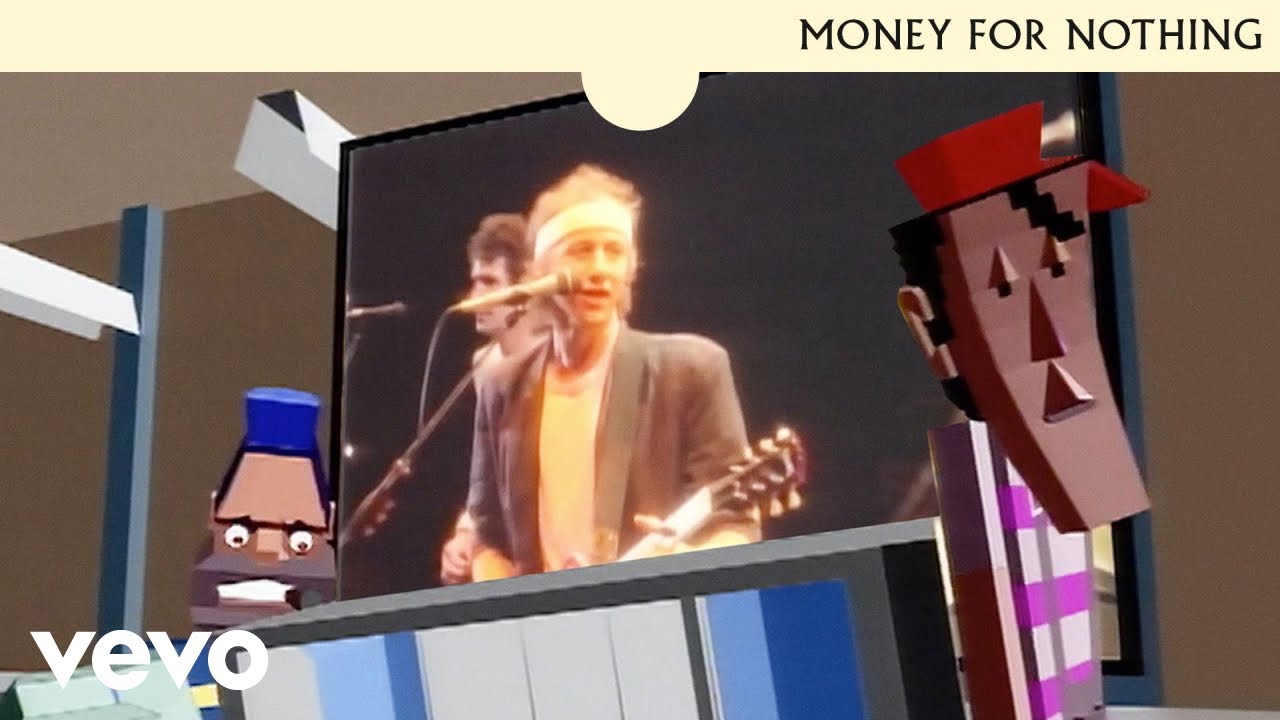
In 1985, a blocky, flat-shaded 3D figure lumbered across television screens, moving appliances around a warehouse. It looked nothing like real life. It looked like nothing anyone had ever seen in a music video.
Director Steve Barron — fresh from a-ha's "Take On Me" — was hired after Warner Bros. pitched the project to Mark Knopfler during a Dire Straits tour stop in Budapest. The concept satirized MTV culture itself: computer-generated workers watch music videos on the TVs they're delivering, griping about rock stars getting money for nothing.
The CGI was created by Ian Pearson and Gavin Blair at Rushes post-production studio in London, using a combination of the Bosch FGS-4000 system and the Quantel Paintbox. Pearson spent three to three and a half weeks working day and night, animating the 3D characters frame by frame. The technology was cutting-edge but severely limited, and the blocky rendering style was partly a necessity rather than a purely aesthetic choice.
The live-action segments featuring the band were shot in Budapest during their tour. Back in London, the footage was run through the Paintbox to add color overlays that mimicked early film tinting, blending the real and digital worlds into a single visual language.
Sting's contribution came about through proximity and coincidence. While writing the song, Knopfler spotted a Police ad for MTV's "I Want My MTV" campaign. During recording sessions at AIR Studios in Montserrat, Sting happened to be vacationing nearby. Knopfler invited him to sing the opening refrain. His label A&M Records later pushed for a co-writing credit, claiming the melody resembled "Don't Stand So Close to Me."
The single hit number one on the Billboard Hot 100 for three weeks and reached number four in the UK. The album Brothers in Arms became one of the best-selling records of the decade. At the 1986 MTV Video Music Awards, the video won Video of the Year — an ironic honor for a song that mocked the very network giving it the prize.
As one of the earliest CGI music videos to air on MTV, "Money for Nothing" demonstrated that computer animation could carry a mainstream pop production. The blocky figures, born from technological limitation, became iconic in their own right — proof that innovation sometimes looks its most striking when the tools are still catching up to the ideas.
Watch the video