It started with a joke that wasn't quite a joke. In 1986, in the house Guns N' Roses shared off the Sunset Strip, Slash sat working through a circular fingering pattern — the kind of thing a guitarist plays without thinking. Slash himself has long downplayed it, calling the riff a bit of a circus exercise, and the "warm-up" story stuck because it fits the band's mythology — greatness arriving by accident in a dirty rehearsal room. But he's also pushed back on the throwaway framing: "It was just me messing around and putting notes together like any riff you do. It was a real riff, it wasn't a warm-up exercise." Whatever it was, the rest of the band heard something in those climbing notes, and within hours they had the bones of a song.
Axl Rose already had the words, or most of them. He'd written a poem about his girlfriend Erin Everly — daughter of Don Everly of the Everly Brothers — and when he heard the melody taking shape downstairs, the poem snapped into place against Slash's riff. The tenderness in the lyric was real, and so was the woman it was about: Erin would later appear in the video itself.
The song was cut during the Appetite for Destruction sessions in early 1987, produced by Mike Clink across a handful of Los Angeles rooms, with Rumbo Recorders in Canoga Park at the center. The famous ending — Axl circling the phrase "Where do we go now?" — didn't arrive in a single inspired take. Before the final sessions, the band sat in the control room with producer Spencer Proffer, looping a demo and trying to crack the song's ending, when Rose started muttering the line to himself. Proffer caught it and told him to sing it. What began as a songwriter's private frustration became the song's haunted fade-out.
In early 1988, Geffen needed a video. "Sweet Child O' Mine" was being readied as the album's third single, and the label wanted something that would land on MTV. Axl had a concept — and by his own later account, it was harrowing: an Asian woman carrying her child into a foreign land, only to discover the child was dead and packed with heroin. The label took one look and said no. Too dark, too disturbing, impossible to put in rotation.
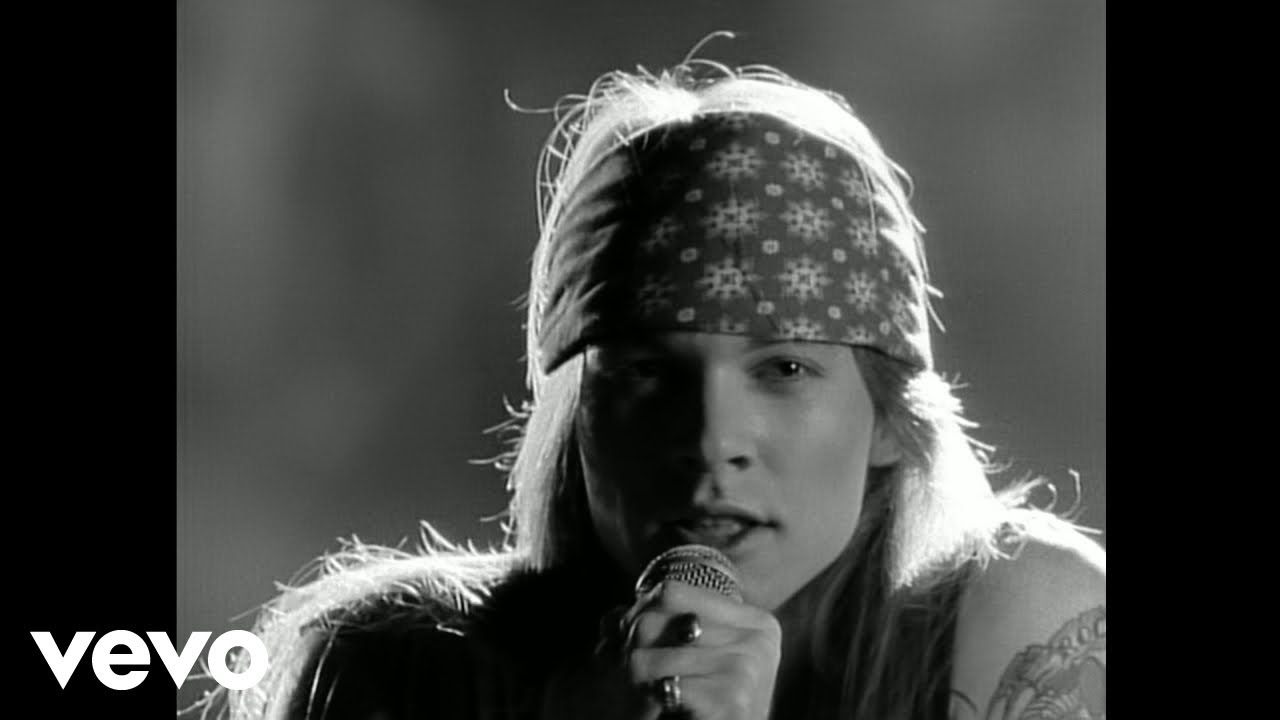
That rejection is where Nigel Dick took over. Dick was no newcomer — he'd directed Band Aid's "Do They Know It's Christmas?" in 1984 and helped launch Propaganda Films in the mid-'80s, and he was fast becoming the go-to director for rock acts in the MTV era. He'd already filmed Guns N' Roses once, for "Welcome to the Jungle." Now, handed a vetoed storyline and a band known mostly for chaos, he made the smartest possible choice: strip everything away and just film the band. No narrative, no effects. Just Guns N' Roses on a bare stage, set up as if mid-rehearsal.
On April 11, 1988, the shoot rolled at Mendiola's Ballroom, 6130 Pacific Blvd. in Huntington Park — a faded old dance hall and short-lived punk club on the edge of Los Angeles, the kind of room that had already seen better days. Dick and cinematographer Vance Burberry lit it deep and murky, leaning into backlight and silhouette: Slash's top hat catching the haze, Axl coiled around the mic stand. In five minutes of footage, Dick locked in a visual template for Guns N' Roses — backlit silhouettes, bare stages, and the sense that you were eavesdropping on a real band rather than watching a constructed rock video. But the masterstroke wasn't the band. It was everyone around them.
Dick filled the frame with the band's inner circle. The girlfriends were all there — Erin Everly, Duff's girlfriend Mandy Brix, Izzy's Angela Nicoletti, Steven Adler's Cheryl Swiderski, Slash's Sally McLaughlin — sitting on the edges of the shoot, watching. Crew members drifted through the frame. Izzy's dog wandered in. The effect was almost documentary: a band famous for decadence and danger suddenly looked like five young men in a room with the people who loved them. One tiny detail seals the intimacy — the dog you hear panting at the very start wasn't caught on set. Editor Michael Heldman added it later, a foley touch on a clip that otherwise feels caught live.
What happened next made the band. MTV put the clip into heavy rotation through the summer of 1988. Radio followed. In September, "Sweet Child O' Mine" hit number one on the Billboard Hot 100 — the only U.S. number-one single Guns N' Roses would ever have — and dragged Appetite for Destruction to the top of the album chart on its way to becoming one of the best-selling debuts in history. For many listeners, the video did the heavy lifting: it made GNR look less like a faceless metal act and more like a real, charismatic band you could fall for.
For Nigel Dick, it cemented a run. "Sweet Child O' Mine" anchored a GNR cycle that carried through "Paradise City" and the narrative-driven "Patience" — clips that grew more ambitious as both the band and the director leveled up. But the one that broke them wide open was the simplest: no story, no spectacle, just a band in an old ballroom, and a riff that was never really a joke.
Watch the video