The song came first, and it came quietly.
During writing sessions for the follow-up to Out of Time, drummer Bill Berry arrived with the bones of an unusually direct ballad. Credits on the eventual album went to all four members, Bill Berry, Peter Buck, Mike Mills, and Michael Stipe, in keeping with the band's shared-credit practice. Mike Mills later told Melody Maker that Berry had written most of it and arrived with the chords on guitar.
The band recorded Automatic for the People through the spring and summer of 1992 — primarily at Bearsville Sound Studios in Woodstock, New York, with overdubs at Criteria in Miami and strings tracked in Atlanta. Scott Litt produced with the band; it was their fourth consecutive album together. "Everybody Hurts" landed as track four. The strings, arranged by John Paul Jones of Led Zeppelin, arrived in the mix as something closer to a hymn than a rock song: sparse, sustained, deliberately plain. Mike Mills played the organ. Michael Stipe sang the way he spoke.
The album was released on October 5, 1992 in the UK and October 6 in the US, and Automatic for the People became, quickly and to the band unexpectedly, one of the most widely received records of their career. "Drive" and "Man on the Moon" went to radio first. "Everybody Hurts" came later. Warner Bros. issued the single on April 5, 1993. It reached number seven on the UK Singles Chart and stayed on it twelve weeks. On the US Hot 100 it peaked at twenty-nine — respectable, but not a reflection of what the song would eventually mean.
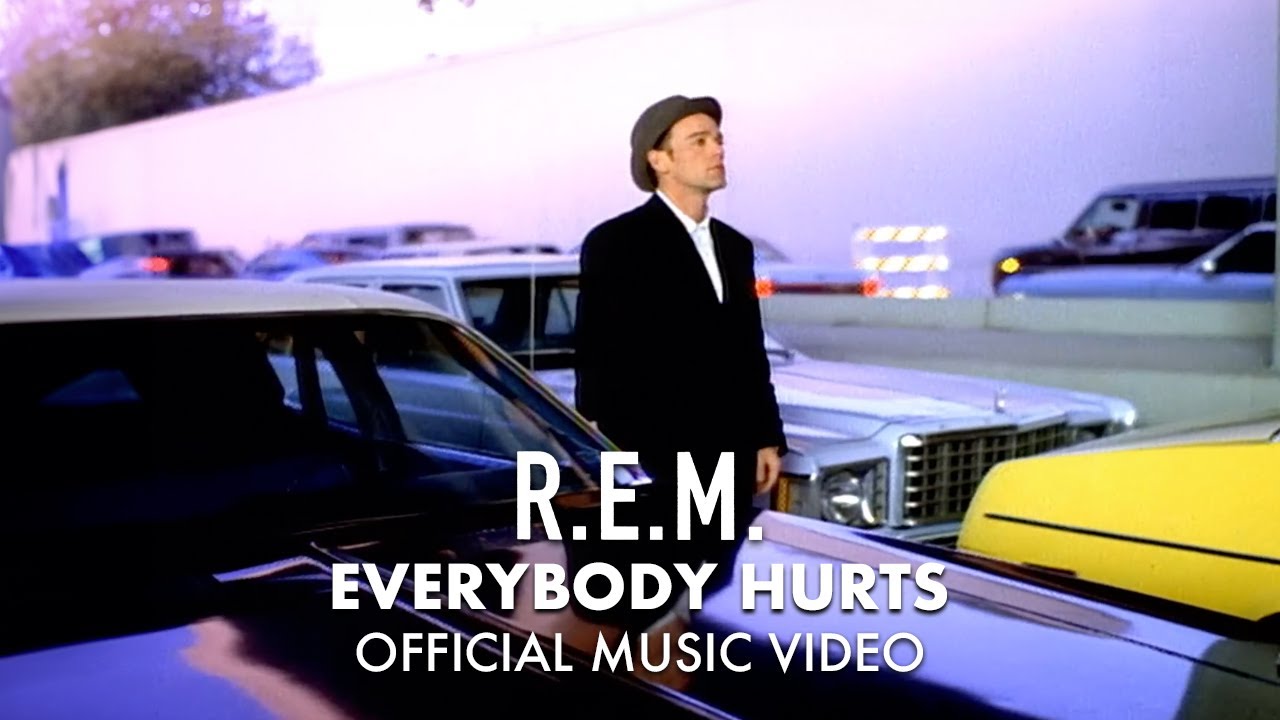
The video came from Jake Scott.
Scott, the son of Ridley Scott, was already working as a music-video director when R.E.M.'s commission arrived. He has described himself, in later interviews, as having been living in Los Angeles at the time, in long commutes, thinking about traffic. His treatment for the video was explicit about its inspiration: the opening sequence of Federico Fellini's 8½, in which the protagonist sits trapped in a dreamlike freeway jam. Scott has said that he wanted to honor rather than imitate Fellini, and to translate the song's "slow roll" and "forlorn, yearning quality" into the visual tempo of a stalled highway.
The shoot took place on Interstate 10 in San Antonio, Texas. Production closed the lower deck of the highway near its junction with Interstate 35, around the Woodlawn and Fredericksburg exits, while the upper deck remained open to traffic. The Texas Department of Transportation and the San Antonio City Council both signed off. According to a local retrospective published decades later, filming ran for approximately three days. A handful of San Antonio residents were hired as extras among the cars. What each driver or passenger thinks — the silent interior monologue rendered on screen as subtitled text — reads as a catalog of ordinary private griefs and worries.
In a 1995 interview with Spin, later paraphrased across the secondary literature, Scott recalled that Stipe had felt "exposed and agoraphobic" during the shoot. What appears on screen is a man who is clearly uncomfortable and willing to let that register.
The video swept the 1994 MTV Video Music Awards: Breakthrough Video, Best Direction, Best Editing, Best Cinematography. It was nominated for Video of the Year but did not win. At the Grammy Awards the same year it was nominated for Best Music Video, Short Form. The Billboard Music Video Awards named it Best Clip of the Year in the Pop/AC category.
The song's status as an unofficial anthem for grief and for mental-health crisis tightened in the years that followed. Not through a single campaign, not through an institutional adoption — by accretion.
Bill Berry had a brain aneurysm in 1995 and left the band in 1997.
Near the end of the video, the people leave their cars and walk; then they vanish, and a newscast reports on the strange event. It is a consolation it did not claim to guarantee.
Watch the video