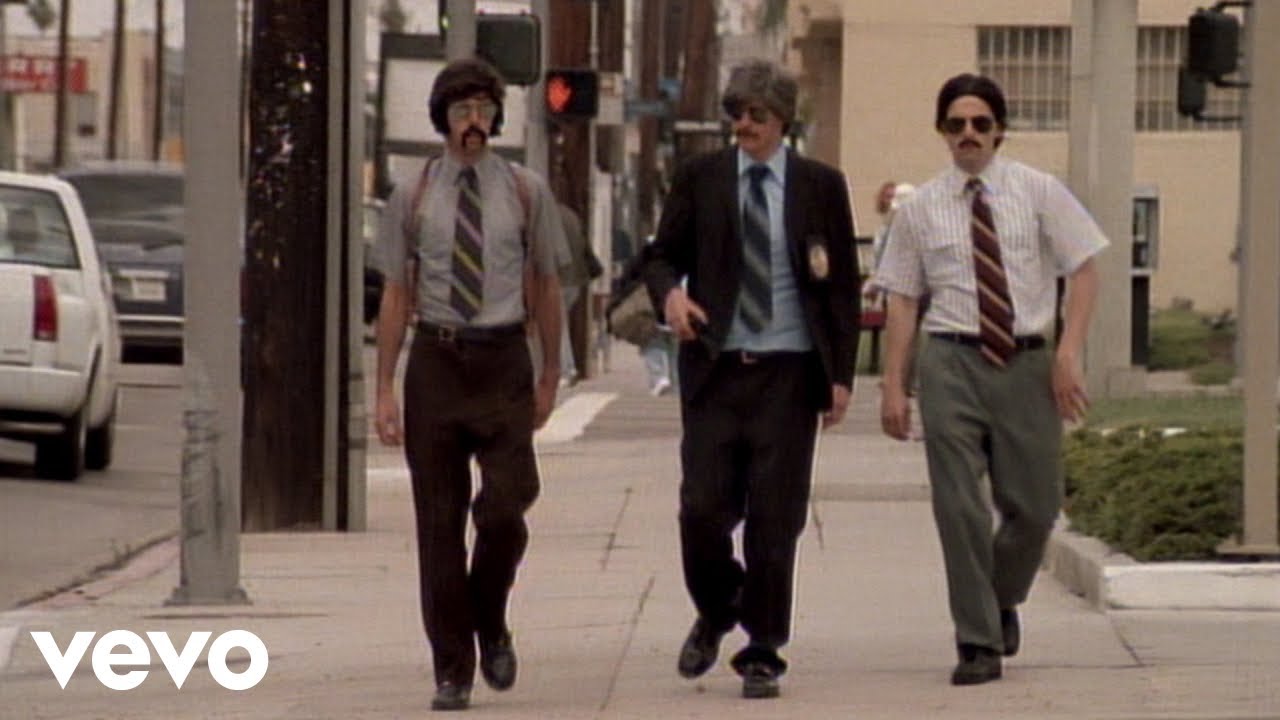
Adam Horovitz had been pitching the idea for a while. The Beastie Boys should dress up as undercover cops on a stakeout — fake mustaches, cheap ties, the whole 70s TV detective routine. No one had bitten.
Then Spike Jonze showed up to a photo shoot wearing a wig and a fake mustache.
Jonze was in his mid-twenties, born in 1969, and had built a career sideways through skate photography and slacker journalism at Dirt magazine before edging into music videos. By the time the Beastie Boys hired him, he had already directed Sonic Youth's "100%" in 1992 and low-budget clips for Dinosaur Jr. His sensibility came from the same DIY tradition as the Beastie Boys themselves. When he turned up in the fake mustache, Ad-Rock's dormant undercover-cop idea came back, and by the end of the shoot it had expanded into a full 1970s cop-show pastiche.
The song came with its own private joke embedded. "Sabotage" was the last track finished for Ill Communication — a harder, guitar-driven version chosen over an earlier take that had sampled Queen Latifah. The lyric was Ad-Rock's idea of a bit: producer Mario Caldato Jr. had been pushing the band to finish the record, and the song pretended to accuse him of sabotaging it.
Having made too many expensive videos they didn't like, the band asked Jonze to shoot with a crew small enough to fit in a single van. No trailers, no lighting trucks, no production assistants standing around with clipboards. That skeleton staffing served a second purpose: it let them shoot without permits. "We just ran around L.A. without any permits and made everything up as we went along," Adam Yauch later said. Jonze treated the job the way he had treated skate videos: friends, a car, a camera, figure it out on the way. They filmed in early 1994 in central Los Angeles, Echo Park, and along freeway overpasses, over the course of a few days.
The video's signature chaos came partly from the equipment. Jonze wrecked at least one rental camera during the shoot — a Canon Scoopic he submerged in a plastic bag to try to get an underwater shot. He reportedly convinced the rental house it had simply stopped working — but the cost still landed on the production. A video originally budgeted in the range of $35,000–$50,000 ended closer to $80,000. A modest overrun that would become one of the best-spent budget blowouts in music video history.
The three band members played named characters out of a fake 70s TV ensemble. Mike D was Sir Stewart Wallace — trenchcoat, glasses, supercilious facial hair. Ad-Rock was Nathan Wind, operating under the alias "Cochese," complete with a curly wig and a Starsky & Hutch mustache. Yauch played Bobby "The Rookie," credited on screen as "Vic Colfari" — a recurring Yauch alias. Yauch's standing alter ego, Nathanial Hörnblowér, is invoked in the video's credits, though the formal direction was Jonze's.
The reference library was specific. Starsky & Hutch, Hawaii Five-O, S.W.A.T., Baretta, and The Streets of San Francisco all fed the video's visual DNA: the frozen-frame introductions with character names in type, the crash zooms, the jump cuts, the foot chases through parking lots, the exaggerated car chases. The hook wasn't any single gag — it was the complete four-minute compression of a lost television genre.
Radio barely played it. "Sabotage" peaked at number eighteen on the Billboard Modern Rock Tracks chart and never crossed over. But MTV put the video into punishing rotation through the summer of 1994, and it became the vehicle that moved the Beastie Boys from hip-hop into the 90s rock audience. At that year's MTV Video Music Awards, it was nominated in multiple categories including Video of the Year. The winner was R.E.M.'s "Everybody Hurts." Yauch, fully in character as Nathanial Hörnblowér, stormed the stage, interrupted Michael Stipe's acceptance, and announced that he had in fact conceived the entire Sabotage video and that its loss was a farce. The bit became its own permanent moment in the band's mythology.
Jonze's trajectory moved fast from there. He shot Weezer's "Undone (The Sweater Song)" later in 1994, then "Buddy Holly" shortly after. Sabotage solidified his position at Propaganda Films, and by 1999 he had directed his feature debut, Being John Malkovich, followed by Adaptation in 2002 and Her in 2013. Rolling Stone has repeatedly ranked Sabotage in the top tier of greatest music videos ever made. Yauch died in 2012, and retrospective coverage has consistently returned to Sabotage and the Hörnblowér VMA protest as shorthand for his particular mix of visual invention and deadpan subversion. The official video has passed several hundred million YouTube views. Three decades on, it remains the clearest answer to what happens when a band, a director, and a rented Canon Scoopic decide not to ask permission first.
Watch the video