In a back bedroom in Malibu sometime in 1975, Don Felder sat with a twelve-string acoustic, an electric bass, and a drum machine, recording demo after demo. One of those tapes — number fifteen, sixteen, somewhere in there — held a chord progression that wouldn't leave his head. He sent the cassette to the band. Don Henley played it back, and the line "on a dark desert highway, cool wind in my hair" began forming in his notebook.
That demo had no title yet. Felder later said the entire shape of the song was already there — the verse, the bridge, the long climb of the outro. What he didn't yet have was a story.
The Eagles had just rebuilt themselves. Bernie Leadon, the country-rock anchor, left in late 1975. In came Joe Walsh, slide-guitar specialist, harder edges, looser stage manner. The band had been tipping toward rock since On the Border, but Walsh's arrival made it official. Their fifth album would not be a folk record. It would be the album where, as producer Bill Szymczyk steered the sessions between Criteria Studios in Miami and the Record Plant in Los Angeles, the Eagles finally let the guitars argue with each other.
The lyrics nobody can stop interpreting
Henley wrote most of the words; Frey helped shape the cinematic frame — a traveler, a lit-up hotel, voices echoing down a corridor. Henley's stated meaning has been consistent across decades of interviews: our interpretation of the high life in Los Angeles and a reflection on the excesses of American life and the illusion of the American Dream. The hotel isn't a building. It's the industry, the era, the version of California that promised liberation in 1969 and delivered cocaine and contracts by 1976.
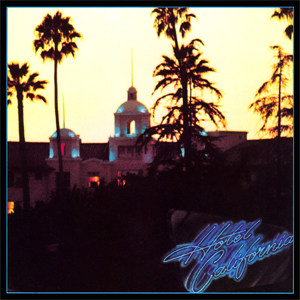
The audience preferred mysteries. The "Hotel California is really Camarillo State Mental Hospital" theory circulated in fanzines. The Beverly Hills Hotel theory grew from the album cover (which is, in fact, the Beverly Hills Hotel — photographed at dusk by David Alexander, art-directed by Kosh, with Boyd Elder's interior artwork). The Anton LaVey / Church of Satan theory spread through evangelical paperbacks in the early eighties. Henley has, at various points, told each of these readers they were wrong.
Some lines have answers. They stab it with their steely knives is a wave to Steely Dan, after Steely Dan name-checked the Eagles in "Everything You Did." Warm smell of colitas is cannabis flower — slang Henley confirmed. We haven't had that spirit here since 1969 drew complaints that wine isn't a spirit; Henley shrugged that the word was poetic.
The two-minute solo
The song's last 2:12 is structured, not improvised. Felder and Walsh trade short phrases. Then they lock into harmonized double-stops over the descending chord progression — Bm, F♯7, A, E, G, D, Em, F♯7 — riding it down to fade-out. Felder built the lines as melodic extensions of the verse rather than scale runs. Walsh added the harmonized counter-line. Both have said the parts were composed before being played, then refined through repeated takes.
Reception, reluctance, return
The album landed December 8, 1976. The single followed February 22, 1977 — edited from 6:30 to 4:50 for radio, with parts of the intro and solo trimmed. It hit number one on the Billboard Hot 100 that May for one week, and reached the UK top ten. At the 20th Grammy Awards on February 23, 1978, "Hotel California" won Record of the Year. The Eagles weren't there. They didn't physically accept the trophy until 2016, in a tribute appearance after Glenn Frey's death.
The band imploded in 1980. Henley and Frey, exhausted and at odds, swore the reunion would happen when hell freezes over. It froze in 1994. The MTV special and live album took the title and gave "Hotel California" a second life — a flamenco-inspired acoustic arrangement, percussion-driven, slower, the harmonies foregrounded. That version found heavy rotation on adult contemporary and classic rock formats and reintroduced the song to listeners who weren't alive when the original charted.
The afterlife
The song has been famously hard to license. Eagles management has turned down film and television syncs that other catalogs would have welcomed. The result is that the studio version — the one with the twelve-string ringing in like a sunset — has stayed scarce in popular media. You hear it on classic-rock radio, in covers, in the jukebox of any roadside bar in California, but rarely in a soundtrack. That scarcity is part of why it still feels like an event when the chord progression starts.
Felder, asked decades later, has summarized the song's subject in plainer terms than any of his bandmates: the underbelly industry in Los Angeles, how it can be less than beautiful.
The hotel was always a metaphor. Most people prefer it to remain one.
Watch the video