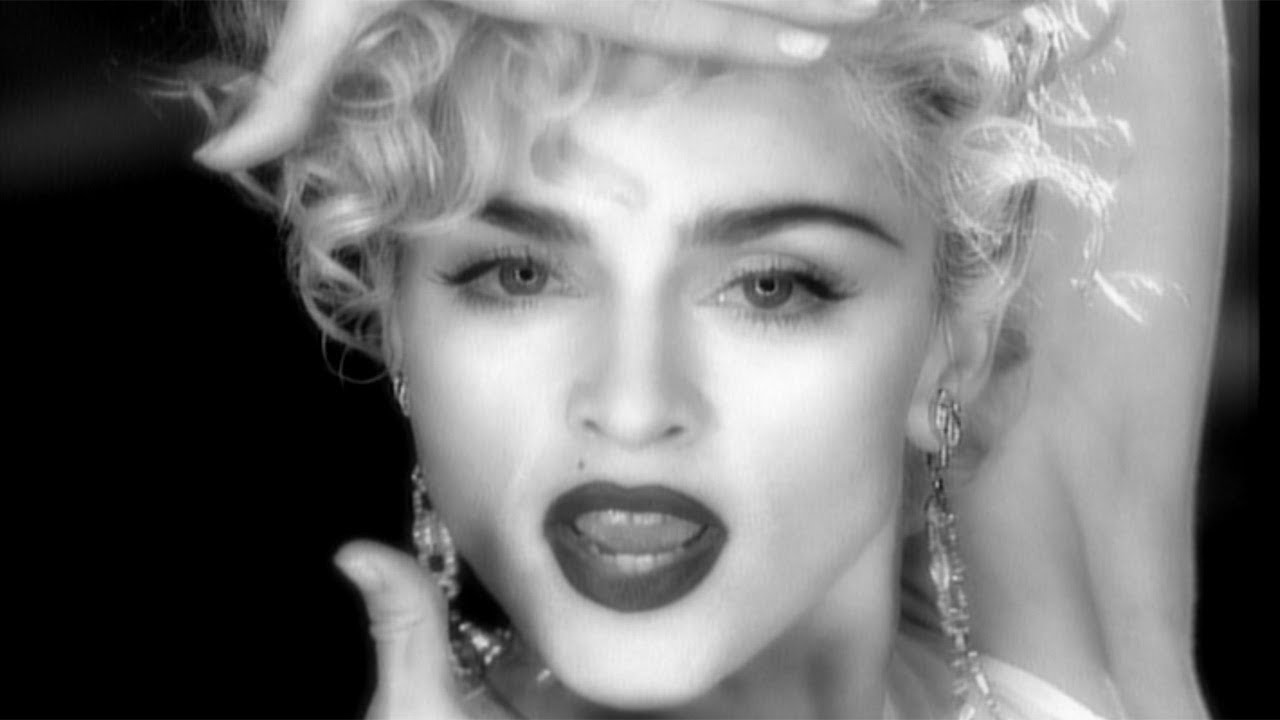
The song that became one of the best-selling singles of 1990 was built on a $5,000 budget in a basement on West 56th Street and originally slated as a B-side.
Shep Pettibone had produced club mixes for Madonna throughout the late 1980s. When Warner Bros. asked him to supply an instrumental for the "Keep It Together" single from Like a Prayer, he worked in a makeshift vocal booth in his basement studio on the budget the label allotted — about $5,000 total, covering studio time, engineers, and session players. Madonna came in, wrote lyrics quickly, and recorded her vocal in a few hours. When Warner executives heard the finished song, they reversed course. Vogue would no longer be a B-side. It would be the lead single from I'm Breathless, the soundtrack tied to Madonna's role in Warren Beatty's Dick Tracy.
The song needed a video fast. Madonna called David Fincher.
Fincher was 27, under exclusive contract to Propaganda Films, and had already directed two videos for her — "Express Yourself" in 1989 and "Oh Father" that same year. He was not yet the director of Alien 3 (his feature debut came in 1992), let alone Seven or Fight Club. He was a glossy, technically precise hired gun with a growing reputation for high-contrast black-and-white imagery.
The production was compressed by force. Madonna was deep in rehearsals for the Blond Ambition Tour, and the only window to shoot was two days in early February 1990 at Burbank Studios in California. The entire video was filmed in roughly 16 hours of studio time, on 35mm black-and-white film, with cinematographer Pascal Lebègue, who had worked with Fincher on earlier stark, high-contrast clips. The visual references were specific and art-historical: the stylized tableaux and hard-edged figures of Tamara de Lempicka's 1920s Art Deco portraits, and the high-contrast studio portraiture of Horst P. Horst, whose 1930s photographs for Vogue and Paramount defined the lighting grammar of Golden Age Hollywood.
The movement came from a world mainstream pop had never spotlighted. Karole Armitage received the choreographer credit, but the vogueing vocabulary on screen — the hand articulation, the duckwalk, the dramatic freeze — came from José Gutierrez and Luis Camacho, members of the House of Xtravaganza, one of the most influential ballroom houses of the underground queer Black and Latino scene in Harlem and the Bronx. Both had been fixtures of the ball circuit since the 1980s. Madonna had first seen them dancing at the Sound Factory, the Manhattan club at the center of late-80s New York nightlife, and brought them onto the set as dancers and ballroom consultants to teach her and the ensemble how the movement should read on screen. Around them were the Blond Ambition dancers who would tour the song that summer: Carlton Wilborn, Salim Gauwloos, Oliver Crumes, Kevin Stea, and Gabriel Trupin, with backup vocalists Niki Haris and Donna DeLory completing the ensemble.
The timing was its own story. Jennie Livingston had been filming Paris Is Burning — the documentary that would introduce outsiders to ballroom culture in depth — since 1986, and by 1990 the footage was circulating on the festival circuit. It wouldn't reach wide theatrical release until 1991. Vogue arrived first. When MTV rotated the video through the spring of 1990, millions of viewers saw the hand movements, the posing, and the duckwalk for the first time — through a Madonna frame rather than the ballroom frame Livingston had constructed.
The song reached number one in more than thirty countries, sold over six million copies worldwide, and is widely described as one of the best-selling singles of 1990. On September 6, 1990, Madonna closed the MTV Video Music Awards at the Universal Amphitheatre in Los Angeles wearing an 18th-century French court gown — a recreation of the Oscar-winning costume James Acheson had designed for Glenn Close in Dangerous Liaisons. Her dancers were costumed in matching baroque aristocratic attire. The collision of Marie Antoinette and Harlem ballroom became one of the most replayed MTV performances of the decade. The video received nine VMA nominations that night and won Best Direction.
Fincher's career moved quickly after. Alien 3 went into production in 1991 under a studio process he has repeatedly described as a nightmare — an experience that nearly ended his filmmaking career before it began. He survived it, and went on to Seven, Fight Club, The Social Network, and Gone Girl — one of the few American filmmakers of his generation to emerge directly from the 1980s music video system into sustained feature authority. José Gutierrez and Luis Camacho continued teaching and performing ballroom internationally. Over the decades that followed — as voguing moved from Harlem basements to FX's Pose to a choreographic vocabulary recognized in every major pop video — a running conversation persisted about how little of Vogue's commercial success ever flowed back to the community that invented its movement. That conversation began here.
Watch the video