"Wonderwall" started out with another title. For a long time Noel Gallagher's song was "Wishing Stone." Then the band listened to George Harrison's Wonderwall Music, the soundtrack he made for the 1968 film Wonderwall. "It was like, 'Brilliant, I've got a Beatles connection!'" Noel said.
What the song is about depends on when you asked him. In 1995 he said it was about his girlfriend, Meg Mathews. In 2002 he took that back on BBC Radio 2: "The meaning of that song was taken away from me by the media who jumped on it. And how do you tell your Mrs it's not about her once she's read it is? It's a song about an imaginary friend who's gonna come and save you from yourself."
Oasis recorded it at Rockfield Studios in Wales in May 1995, with Owen Morris co-producing. Noel had an idea: "I've got this song called 'Wonderwall', I want to record it on a wall." He tried it outside, among ladders, microphones and sheep, and gave up. The finished track was made inside the studio, essentially in one day, with a piano part added later. Noel played the bass himself, and Alan White played drums. The low line that sounds like a cello is Bonehead on an old Mellotron. According to Morris, Noel let Liam choose between "Wonderwall" and "Don't Look Back in Anger." Liam took "Wonderwall", and Noel sang the other one.
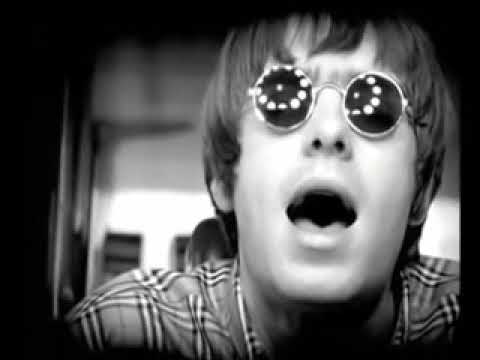
The video went to Nigel Dick, who had already filmed Oasis in Southend for "Rock 'n' Roll Star." Dick recalled the brief: "Noel says he wants it to be in black and white with bits of colour in it." The record company added a warning: "For God's sake don't ask them to act or they'll walk off the set, try and find something fun for them to do."
So the band does not act. Dick filmed on 30 September 1995 at Unit 217B in Woolwich, south-east London, and built the video from objects and side acts around the band: a cellist and saw players, an old record player, a puppet, a showgirl inspired by a still from the Beatles' film Help!, and a clown. "I needed another element," Dick said of the clown. The film was shot in colour and turned black and white afterwards, with green paper taped to props so that chosen details could be coloured back in.
One of the clowns was Colin Maher from Bognor Regis. "Liam was a little bit fiery at the best of times," he told ITV News in 2024. "As soon as I met them, I was just being myself, and we got on together like a house on fire." One member is missing: the bassist Paul "Guigsy" McGuigan, who was away from the band that autumn. Scott McLeod stands in his place.
Dick remembers the day as "a bloody nightmare." The band arrived a couple of hours late, the location was cold and hard to find, and the producer Phil Barnes had to leave when his wife went into labour. None of that shows. Liam stares into the camera through his sunglasses, and the clown juggles.
The single came out on 30 October 1995 and went straight to number two in Britain, behind Robson & Jerome's "I Believe" and "Up on the Roof." In America it reached number eight on the Billboard Hot 100, Oasis's only top-ten hit there, and spent ten weeks at number one on the Modern Rock chart. In February 1996 the video won the Brit Award for British Video of the Year.
The song soon had a life of its own. That Christmas, the Mike Flowers Pops took an easy-listening version to number two. Ryan Adams covered it, and Noel said: "I never got my head round this song until I went to see Ryan Adams play and he did an amazing cover of it." In 2020 "Wonderwall" became the first song from the 1990s to pass a billion streams on Spotify, and BBC Radio 2 has called it "a mainstay for buskers the world over."
Oasis came back in 2025, and on the reunion tour it came near the end of the show. The video is still the same shoot in Woolwich: a band nobody asked to act, a clown and a record player, in black and white with a little colour.
Watch the video