The opening image is a rocket in the moon's eye.
It's from 1902. Georges Méliès' Le Voyage dans la lune — widely regarded as the first significant science fiction film — shows a bullet-shaped spacecraft landing in the face of a personified moon. In the spring of 1996, Jonathan Dayton and Valerie Faris looked at the cover of an album called Mellon Collie and the Infinite Sadness, with its art-nouveau illustration of a seated woman and star-scattered backdrop, and found themselves thinking about Méliès. They pitched it instead of the Busby Berkeley routine that had originally been on the table.
"Tonight, Tonight" is the second track on the first disc of Mellon Collie and the Infinite Sadness, The Smashing Pumpkins' double album released on October 23, 1995. Written by Billy Corgan alone, produced with Flood and Alan Moulder, it opens with an orchestral string figure that by 1995 was deeply unusual in alternative rock. Corgan has described the song, repeatedly in later interviews, as autobiographical — a song about leaving his hometown of Chicago and the destructive circumstances that had shaped him there. "The impossible is possible tonight" is the chorus line. In a 2012 Howard Stern Show interview he framed it as being about himself, and how he was able to get out of his hometown of Chicago to pursue his dreams.
The orchestral arrangement was recorded in Chicago. The widely repeated claim that the Chicago Symphony Orchestra plays on the track cannot be verified in any surviving primary source; it appears to be a later conflation with orchestral live arrangements of the album performed in Chicago. The track contains, more accurately, a full orchestra recording whose exact ensemble is not named in the album credits.
The song was released as the fourth single from the album on May 6, 1996, after "Bullet with Butterfly Wings," "1979," and "Zero." By the time the video was commissioned, Dayton and Faris were already veterans of the medium. They had produced MTV's The Cutting Edge in the late 1980s, introducing American audiences to bands like R.E.M. and the Red Hot Chili Peppers. Married to each other and working as a unit, they had built a reputation for visual shapeshifting — absorbing the persona of each act rather than imposing a signature.
For the Pumpkins, they proposed Méliès.
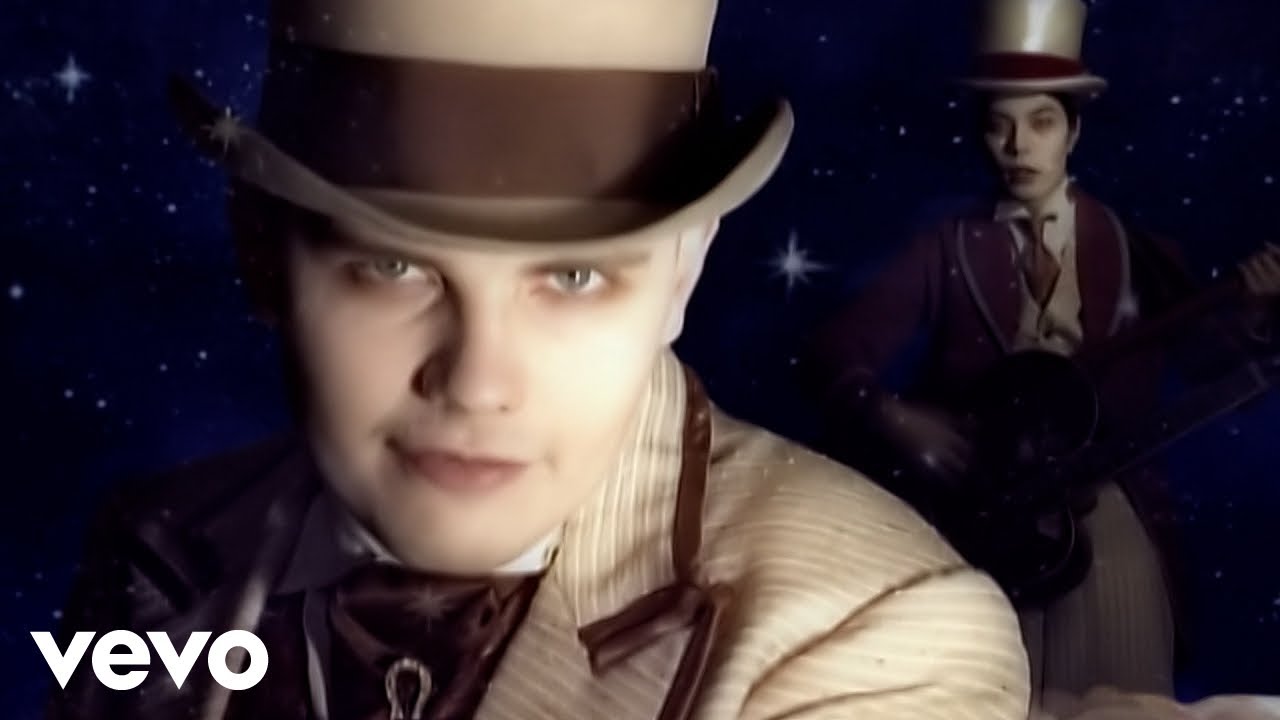
The turn-of-the-century frame drove everything that followed. Wayne White, the artist who had designed puppetry and backdrops for Pee-wee's Playhouse, was engaged as production designer. He built what he later described as a giant series of flat paintings — painted theatrical flats and rear-projection screens that turned a Los Angeles soundstage into a century-old proscenium. The costumes were a production problem of a kind that only 1996 could offer: James Cameron's Titanic was filming at the same time, and had rented most of the available period wardrobe in Los Angeles. What remained had to be altered and re-sewn into the Edwardian-adjacent looks seen in the video.
No digital compositing is visible. The rear projections, the miniatures of rockets and fish, the puppetry, the painted backdrops, the forced perspective — all are practical. The strongest statement defensible here is that the visible effects are theatrical rather than CGI; no one on the crew has publicly documented a promise of zero post-production digital work.
Billy Corgan appears as a conductor in Edwardian dress. James Iha, D'arcy Wretzky, and Jimmy Chamberlin play as an orchestra. The couple who travel through the narrative — the ones who ride a rocket into the moon's eye, are captured by Selenites, dive from a ship, and fall back to Earth through a sea of painted waves — are the comedians Tom Kenny and Jill Talley, a then-newly married couple who remain married today. Their journey tracks the original Méliès film closely, with cosmetic additions: an underwater sequence with oversized painted fish that critics have subsequently read as homage to Méliès' later films The Kingdom of the Fairies (1903) and The Impossible Voyage (1904), though no public statement from Dayton or Faris pins the inspiration to those specific titles.
The video premiered in May 1996. By early September it had collected eight MTV Video Music Award nominations. On September 4, at the ceremony, it won five Moonmen: Video of the Year, Breakthrough Video, Best Direction, Best Special Effects, Best Art Direction, and Best Cinematography. At the same ceremony, "1979" won Best Alternative Video, bringing the band's haul for the night to seven.
The moment was shadowed. On July 12, two months before the ceremony, the band's touring keyboardist Jonathan Melvoin died of a heroin overdose in a New York hotel room. Jimmy Chamberlin was with him, was arrested, and was subsequently dismissed from the band. Later chronicles describe 1996 as both the commercial zenith of the Pumpkins' career and the beginning of its unraveling.
Dayton and Faris kept directing music videos — for Oasis, the Red Hot Chili Peppers, Weezer, and others — before taking a feature screenplay called Little Miss Sunshine into production a decade later. It was released in 2006, received four Academy Award nominations, and won two: Michael Arndt for Best Original Screenplay, Alan Arkin for Best Supporting Actor. In interviews after the film's success, both directors have spoken about how music videos taught them to build strong visual concepts on limited budgets. Neither has named "Tonight, Tonight" specifically as the work that made their feature career possible. It has, in retrospect, been the video most consistently named by critics as the one that did.
Georges Méliès died in 1938, largely forgotten, eventually running a small toy-and-sweets kiosk at the Montparnasse railway station. In 2011, Martin Scorsese would make Hugo, a film about his rediscovery. Fifteen years before Hugo, a Smashing Pumpkins music video had already put the image of a rocket in the moon's eye into heavy rotation on MTV, and introduced a generation of teenagers to a French magician who had invented the visual grammar they were now applauding.
Watch the video